India
 Canada
Corporate Genie Newsletter · Nov 25, 2026
Every December, our phones ring with the same question. It usually comes around the 20th, and it usually sounds like this: “The portal is showing a difference in Table 8. What do we do now?”
By then, the honest answer is often: not very much. Most of what decides how a GSTR-9 turns out was settled months earlier. It was settled in how the monthly GSTR-3Bs were filed, in how credit notes were handled, and in whether anyone compared GSTR-2B with the purchase register before the books were closed.
That is the real nature of the annual return. It is not a new return so much as a mirror. It places twelve months of filings side by side and asks one simple question: does it all add up?
For FY 2025-26, that question is harder to answer than usual. Below is what has changed, the problems we keep running into while preparing these returns, and the checklist we are using with our own clients this season.
If this reaches you before 30 November 2026: that is the last date to claim any input tax credit of FY 2025-26 that you have not yet taken in GSTR-3B (Section 16(4)). GSTR-9 cannot be used to claim credit you missed. Check your pending ITC first, then read on.
Who needs to file, and by when
| Aggregate turnover (FY 2025-26) | What applies |
|---|---|
| Up to ₹2 crore | GSTR-9 optional (exemption continues under Notification No. 15/2025-CT) |
| Above ₹2 crore | GSTR-9 mandatory |
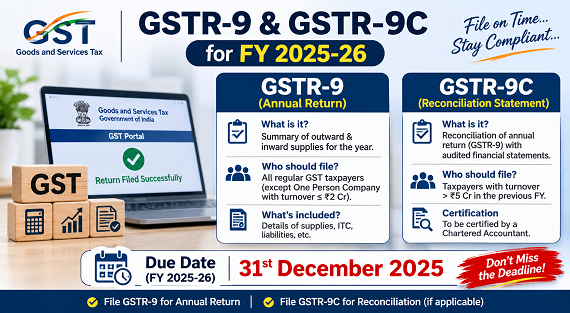
| Above ₹5 crore | GSTR-9 and GSTR-9C (self-certified reconciliation statement) |
The due date is 31 December 2026. GSTN enabled both forms on the portal from 8 October 2026, but the filing tile opens only after every GSTR-1 and GSTR-3B for the year has been filed. A single pending return from, say, August 2025 will hold up the whole exercise.
One word on the ₹2 crore exemption. Optional does not mean irrelevant. If your year included rate changes, amended invoices or credit claimed late, a reconciled annual return can be a useful record of your position. It is worth a conversation with your advisor before you decide to skip it.
Why FY 2025-26 is not a routine year
- The year is split into two rate periods. GST rate rationalisation came into force on 22 September 2025. That means 1 April to 21 September 2025 sits under the old rates, and 22 September 2025 to 31 March 2026 under the new ones. In practice:
- The same HSN may appear twice in Table 17, at two different rates.
- A credit note issued after 22 September against an earlier sale should carry the old rate, not the new one.
- In GSTR-9C, the rate-wise tax reconciliation (Table 9) is where most of this year’s effort will go.
- Table 8A now comes from GSTR-2B. With the Invoice Management System shaping what lands in GSTR-2B, the credit you accepted, rejected or kept pending during the year flows straight into the annual return. The downloadable Excel now also shows why the portal excluded a particular invoice (wrong place of supply, reverse charge, late filing by the supplier, and so on). The difference you report in Table 8D is, in our experience, where most scrutiny begins. Leave it unexplained and you are inviting a question.
- Some relaxations continue, others are gone for good. The optional reporting relief has been carried forward to FY 2025-26. You can still combine certain lines (for example, inputs and input services in Table 6, with capital goods shown separately), and Tables 15, 16 and 18 remain optional. In GSTR-9C, the detailed turnover adjustments can be reported as a net figure with an explanation, and the expense-wise ITC reconciliation in Table 14 remains optional.
What is not optional any more: the row-wise reporting of ITC reversals in Table 7, and the cross-year disclosures in Tables 12 and 13. These relaxations were withdrawn from FY 2024-25 and stay withdrawn. Another area to watch is the difference between Table 6A1 (ITC of the previous year claimed in this year) and Table 6H (ITC reclaimed after an earlier reversal, such as under Rule 37 or 37A). Mixing up the two is one of the most common errors we see.
- There is no second attempt. GSTR-9 and GSTR-9C cannot be revised once filed. The annual return also cannot be filed at all after three years from its due date. And with demands for FY 2024-25 onwards now governed by Section 74A, whose time limits are linked to the due date of the annual return, whatever you file becomes the reference document for any future proceeding.
The challenges we keep running into
None of these are exotic. They are the same issues, in different proportions, at almost every business we work with.
Books and portal turnover don’t match. Year-end provisions, unbilled revenue, advances, credit notes passed only in the books, supplies to branches in other states, and audit adjustments made after the last GSTR-3B. Each of these is legitimate. Each also has to be explained line by line in GSTR-9C.
Supplier timing. A vendor files late, and the invoice shows up in GSTR-2B of the next year. Suddenly you are dealing with Table 8A, Table 13 and the next year’s Table 6A1 for a single bill.
Credit in the wrong bucket. Capital goods booked as inputs. Blocked credit under Section 17(5) claimed and reversed in one combined line. Reversals under Rules 37, 42 and 43 bunched together instead of being reported separately as Table 7 now requires.
HSN data that doesn’t tie up. Table 17 is pre-filled from GSTR-1, but entries can fail to load without any warning, and businesses with more than 500 HSN lines have to use the offline utility. The total still has to match your sales.
Multiple GSTINs, one set of books. The audit is done for the entity, but GSTR-9 and GSTR-9C are filed per GSTIN. Splitting audited turnover and credit state by state is often the most time-consuming part of the whole exercise.
Short payment discovered late. If the reconciliation shows tax was underpaid, it has to be paid through DRC-03 with interest, typically in cash, before you file. Excess tax paid, on the other hand, cannot be adjusted or refunded through the annual return.
Our working checklist before you click “File”
- Finalise the books first. GSTR-9C figures must tie back to your audited trial balance. Filing on provisional numbers is how differences get locked in.
- Reconcile GSTR-1 against GSTR-3B, month by month, including any GSTR-1A amendments.
- Reconcile GSTR-2B against the purchase register, and write down the reason for every material gap you will report in Table 8D.
- Split the year at 22 September 2025, for sales, purchases and credit notes alike, and check the rate applied on each.
- Capture FY 2025-26 transactions reported in later months (amendments, late credit, reversals) correctly in Tables 10 to 13.
- Validate the HSN summary in Table 17 against total outward supplies.
- Pay any shortfall through DRC-03 before filing, along with interest.
- Keep your working papers, including the Table 8D explanation and the expense-wise ITC working, even where the table itself is optional. Officers ask for them.
- File GSTR-9 first, then GSTR-9C. The late fee keeps running until both are filed.
- Don’t plan around the last week. The portal slows down sharply after mid-December, and an extension is never guaranteed.
What a delay actually costs
| Aggregate turnover | Late fee per day (CGST + SGST) | Maximum |
|---|---|---|
| Up to ₹5 crore | ₹50 | 0.04% of turnover in the State/UT |
| ₹5 crore to ₹20 crore | ₹100 | 0.04% of turnover in the State/UT |
| Above ₹20 crore | ₹200 | 0.5% of turnover in the State/UT |
The fee is the smaller concern. The bigger cost is a return filed in a hurry, with differences nobody had time to explain, that later becomes the basis of a notice.
A closing thought
We often tell our clients that the annual return is not paperwork for the department. It is the clearest picture you will get all year of your own GST position. The businesses that treat it as a review, and not a December fire drill, are the ones that rarely hear from the department afterwards.
So here is our question for you: which reconciliation eats up the most of your time every year? Is it 2B against books, turnover across GSTINs, or something else entirely? Tell us in the comments. We read every one, and the most common answers will shape our next edition.
Need a second pair of eyes on your GSTR-9 or GSTR-9C? Corporate Genie is a multi-disciplinary team of Chartered Accountants, Company Secretaries, Advocates and Management Consultants. We help businesses reconcile, file and defend their GST position.
🌐 corporategenie.in· 📞 +91-8700202997
This newsletter is for general information and reflects the position as on the date of writing. Please check the latest notifications or speak to a professional before acting on it.
#GSTR9 #GSTR9C #GSTAnnualReturn #GSTCompliance #GSTIndia #CharteredAccountant #TaxCompliance #CorporateGenie